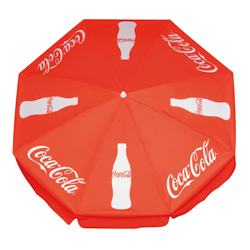


There are different textile printing techniques for printing on parasols. Depending on the design, the product, the quantity and what the parasol will be used for, a particular printing technique is applied. To get the best possible result from your promotional parasol, Schirmmacher offers various printing methods.
Digital Printing
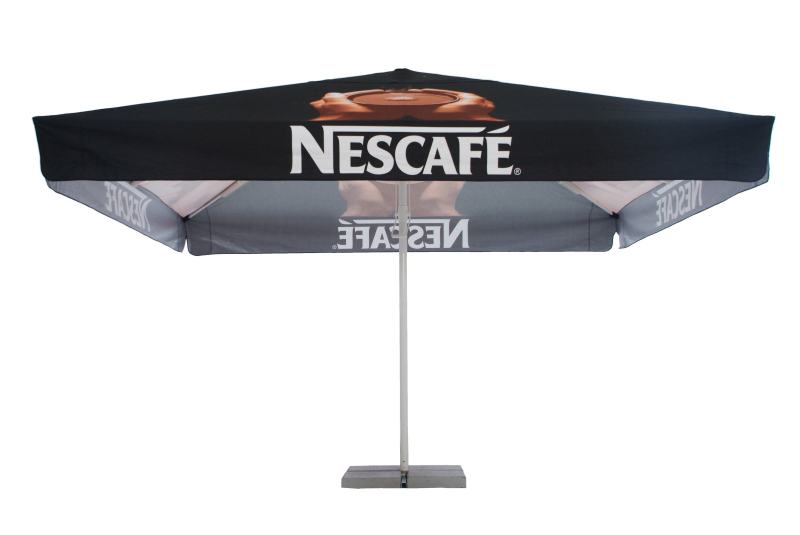
- An inkjet printer prints special pigment inks directly onto the textile, which are then permanently fixed using heat.
- Advantages:
- Designs in photo quality
- Colour gradients are possible
- Printing possible even in small quantities
- The fabric stays pleasantly soft
High wash resistance
- Can be used as an all-over print
- Disadvantages:
- Printing on coloured fabrics is problematic
The printing method is not efficient for large quantities
Manual Screen Printing
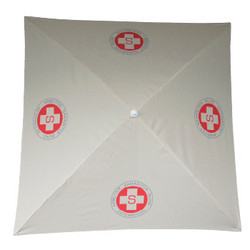
First, the desired print design is printed onto a film (transparent sheet). The film is then placed onto a printing screen coated with a polymer layer. Both the film and the screen are then exposed to UV light. This causes the exposed areas of the mesh to harden and become impermeable to ink, while the unexposed areas can simply be washed out.
- The resulting screen is placed onto the fabric to be printed like a stencil. Using a so-called squeegee, the ink can now be drawn through the permeable areas of the screen, transferring the logo directly onto the fabric.
- Advantages:
- Can be used even for small quantities
- High lightfastness
- High durability
Relatively high colour accuracy
- Ideally suited for most logo designs
- Disadvantages:
- Only possible on fabrics held in stock
- Colour gradients are problematic
From a certain quantity of parasols to be printed, it can be worthwhile to turn to more specialised printing techniques. Should this be the case for you, we will inform you accordingly. One example of this is mechanical flatbed printing.
Mechanical Flatbed Printing
- Mechanical flatbed printing is a screen printing process and, technically, follows the same principle as the manual screen printing already described. Thanks to mechanical processing, and unlike manual screen printing, colour gradients and photo designs can be produced.
- Advantages:
- Efficient for large quantities
- High lightfastness
- Relatively high colour accuracy
Flexible design options
- Can be used as an all-over print
- Disadvantages: